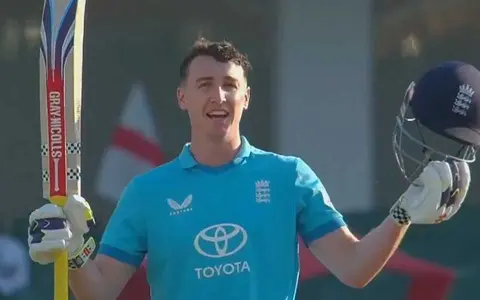
England captain Harry Brook made history with a stunning 202-run knock against Sri Lanka in the Pakistan ODI Tri-Series on October 22, 2026. He became the first England batter to score a double century in One-Day Internationals.
Brook reached the landmark in just 114 balls at Rawalpindi. His innings also made him the fastest batter to score an ODI double century. He broke the previous record of 117 balls held by India’s Shubman Gill.
The England captain smashed 21 fours and 10 sixes during his remarkable innings. He was dismissed on the final ball of England’s innings. His effort helped England post a massive total of 429/4, the highest ODI score recorded on Pakistani soil.
Harry Brook Breaks Multiple ODI Records With Historic Knock
Brook’s 202-run innings surpassed Ben Stokes’ previous record of 182 against New Zealand at The Oval in 2023. He now holds the record for the highest individual score by an England batter in ODI cricket.
The 27-year-old also became only the second non-opener to score an ODI double century. Australia’s Glenn Maxwell was the first to achieve the feat with his unbeaten 201 against Afghanistan in the 2023 World Cup.
Brook shared a 159-run partnership with Joe Root before adding 185 runs with Will Jacks. These stands helped England maintain their scoring rate and reach a record total.
The innings also added another achievement to Brook’s international career. He became only the second player, after Chris Gayle, to score a century in T20 Internationals, a double century in ODIs and a triple century in Test cricket.
Brook had scored his Test triple century against Pakistan in Rawalpindi in 2024.
His latest achievement also strengthened his record as England captain. All four of his ODI centuries have come while leading the national team.
With his historic double century, Brook has joined an elite group of batters who have scored 200 or more runs in an ODI innings. His performance will remain a major milestone in England’s limited-overs cricket history.